
Prophetstown Area Historical Society November 2020 – Updated February 2024
Prophetstown Parking Meters
At the Prophetstown Area Historical Society meeting on November 14, 2020, I (Fred South) was asked by Mark Thompson for what I knew about the parking meters that once graced the streets of our business section. That was a new one for me; I had no idea they ever existed in our community. He then told us what his father, Bud Thompson, remembered about them.
When we came to town in 1964 there were no parking meters. Bev Peterson came in 1958 and there were none here then either. With this in mind, I began a search of the old Prophetstown Echo and below is what I found, with a couple of comments by our older residents.
From City Council minutes it was clear that there was a problem with the parking on Washington Street. It seems that many of those who worked in the stores parked their cars in the business section. Also, in the earlier times most of the apartments above the stores held residents who also parked on Washington Street, leaving not nearly enough spaces for those who wanted to park while shopping. However, the installation of parking meters appears, from the City Council reports, to have been for added income, primarily, but as you can see in the June 1953 article they reckoned it would help prevent the present “parking abuses on Washington Street.”
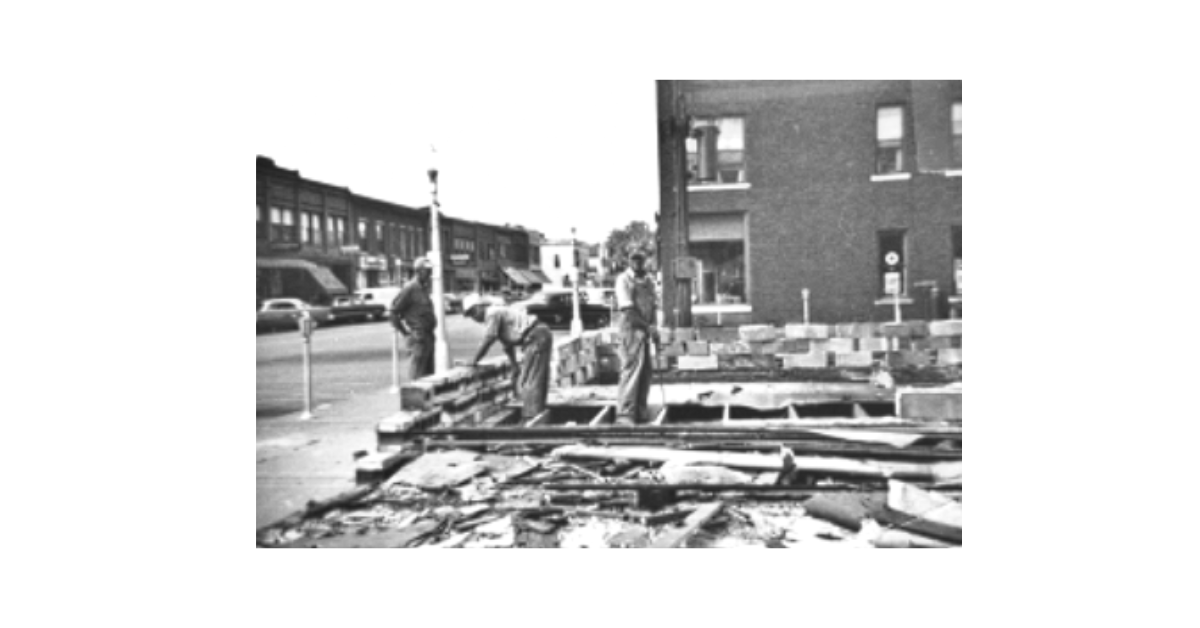
Searching through street scene pictures in the PAHS computer, this was found, indicating that there were parking meters on Washington Street and even on Short Street. Here is a photo of workmen tearing down the old wood-frame sandwich shop-ice cream parlor that once stood on the southeast corner of Washington and Short in 1954. You can clearly see the meters.
 |
Bud Thompson memories:
“I really don’t remember the dates but Jess Urick who owned the Ace Hardware Store, put paper bags over the ones in front of his building. He and the mayor had quite a row.”
Cal Schuneman memories:
“I could not recall just when the parking meters were installed, but certainly remember the event. The issue was partly one of revenue, but also some merchants and employees parked downtown without regard for saving spaces for customers. Once the meters were installed, most of us found other places for long time parking. Customers were unhappy, and finally the merchants prevailed upon the city to remove them.”
From the Echo, June 3, 1953:
COUNCIL DISCUSSES PARKING
Figures on Cost to be Submitted at July Meeting;
Treasurer Reviews City Finances.
The desirability of installing parking meters in Prophetstown was discussed at some length Monday evening at the regular meeting of the city council and Mayor L. K. Groharing directed H. L. Germann, street and alley chairman, to secure figures as to probable cost of meters and installation, possible revenues, etc., for presentation at the next meeting when the matter will be taken up at greater length. Members of the council favorable to meters maintain that they will not only eliminate some of the parking abuses on Washington Street but will bring in added revenue which the city needs badly to make possible many improvements which cannot now be attempted.
From the Echo, July 8, 1953:
“At the conclusion of the meeting a general discussion of the parking meter question was taken up and members of the board expressed themselves as to the reality of installing meters here. Both the mayor and his aldermen feel that there is an accumulation of work ahead of the city now which must be done if Prophetstown is to continue to progress, permanent improvements which are necessary to keep the community abreast of the times and desirable as a place of residence, these include such major projects as permanent street paving, comprehensive sidewalk repair, purchase of maintenance equipment, etc. Year-after-year these projects must be postponed because of lack of funds and some of the councilmen feel that under present sources of city revenue they can never be attempted. For that reason they feel that a new source of income must be found and that parking meters are about the only answer. Alderman H. L. Germann has been collecting date on probable yearly revenues to be expected if 125 meters were installed in Prophetstown, on the cost of installation and operation and on the experience of nearby communities of this size with meters. The aldermen hope to arrive at some conclusion as to the net advantages of meters and to evaluate as closely as possible the objections to them, not wishing to make any move in the matter until a careful study has been made. Mayor Groharing expressed himself as anxious to have the comments from the public and hopes that any help that can be given them in making a decision for the best interest of the city will be forth coming.”
I have searched the Echo for the years 1953 and 1954 and can find no evidence listed where the City Council received any comments relative to installing parking meters. At least nothing was published in the Echo. Perhaps councilmen just talked to people on the street.
From the Echo, August 5, 1953: From the Echo, August 25, 1953:
 |

Parking in Effect Sept. 1 Workmen Install 150 Meters Here in Three Days This Week; Painting Stalls Next.
The installation of parking meters in Prophetstown was completed today and they will go into operation Tuesday, Sept. 1. The meters were installed by the Leslie Kilberg cement contracting workmen under the supervision of the Duncan Parking Meter Corporation’s installation engineers E. C. Barnes and E. Toomey. The task of installing the meters was started Monday and was practically complete at the end of three days. There are 150 meters in all set up at this time. All meters are two hour meters with the exception of several twelve minute meters at the bank and several more at the post office. Funeral homes will be protected in that they will be provided with zippered hoods with NO PARKING printed on them, which can be used at the time such services are held.
Most meters installed here are the minimum 18 inches distance from the edge of the curb. Holes, 3¼ inches in diameter, were drilled to hold the 37 inch pipe cemented in them. The meter itself adds another 15 inches to the height of the installation. Where the cement sidewalk did not extend to the curb ground settings were used. Black top was used some places to extend the curb or width of the walk. Parking meter zones described are created on the following streets in Prophetstown: Washington Street, from Second Street to the northerly track of the C. B. & Q. Railroad; Third Street, from Washington Street east to the alley half a block east of Washington Street; Third Street from Washington Street west to the alley half a block west of Washington Street; Short Street, from Washington Street to the alley east; Railroad Street, from Washington Street east 100 feet; the north half of Railroad Street, from Washington Street west to the alley, a half block. The trial of parking meters in Prophetstown was voted by the City Council in a regular meeting held Monday, Aug. 3.
Now that the meters have been installed the painters will proceed to paint the meter stalls and no parking signs. Penalty boxes will be placed for violations, in convenient locations. All work in connection with the meters should be completed by Saturday, Aug. 29.
From the Echo, October 7, 1953:
Business Men Frown on Parking Meters
The gist of the complaint was that the meters were alienating many customers and that the fine was excessive at 25 cents per ticket. Furthermore, the complainers were told that the parking meters were installed and contained a contract of one year.
(The 25 cent fine in 1953 would be equivalent to a fine of $2.82 in 2024.)
From the Echo, October 14, 1953:
Parking Meter Committee Set Up by Booster Board
Discussion of parking meters in Prophetstown featured the October meeting of the Prophetstown Boosters executive board Tuesday evening, a number of business men not on the board attending to explain their objections to the meters and talk over the matter.
The general consensus, both of board members and visitors, was that the rigid enforcement of meter time embarked upon originally by the city council was extremely inadvisable, creating hard feelings which in many cases reacted against the interests of the business man, and it was agreed that a request for relaxation of, the policy be tendered to the council from the Booster board. In response to requests that the Boosters ask for abandonment of the meters altogether, President Calvin Schuneman appointed a committee consisting of Ray Miller, Henry Oberle, Jr., Charles Mulcay, J. B. Reichard and himself to meet and try to arrive at some plan for investigating the matter on an impartial basis, their duties to include taking a poll of the merchants as to how they feel about meters.
From the Echo, November 4, 1953:
Business Men Present New Anti-Parking Meter Petition
A petition bearing the names of 45 Prophetstown business men asking the removal of parking meters from Prophetstown streets was presented to the city council Monday evening at the regular November meeting. Representing almost every business house in the city before which meters are located, the petition showed that approximately 90 per cent of the firms most directly involved are actively opposed to meters and the petition explained that they felt that the meters are not in the best interests, of Prophetstown. Of the 53 business houses polled, the proprietors of only four expressed themselves as favoring meters. Four others declared themselves opposed to meters but declined to sign the petition.
City Clerk Mabel Harms reported that parking meter collections during November were $703.37 and that total collections since installation of the meters have been $1,946.09. Penalties in addition have totaled $239. A request for a delivery sticker permit to enable trucks to stop in metered areas to make deliveries upon payment of a stated yearly fee was presented by Mayor Groharing and discussed
by the council but no action was taken. It was agreed to suspend operation of the meters all day Saturday, Dec. 19, the day the Prophetstown Boosters will bring Santa Claus here and give candy to the children of the area.
[The $239 in penalties would amount to about $2,736 in 2026 dollars.]
From the Echo, August 4, 1954.
City Council Meets Twice Over Week-End
Most of the Council’s business was confined to a general discussion of parking meters and the renewal after the one year trial period expires September 1. The Council does have an additional 30 days beyond that date in which to act. A delegation of around one dozen business men appeared before the Council Monday to present their views. Figures on the returns from eleven months operation of the meters were given during the session. During the 11 month period $6,690.06 has been collected. One half of the returns go to the installing company until the cost of the meters, $9,825, is paid. At the present rate of return this would take about 2 ½ years to pay for the meters should they be discontinued. As to what has been done with the city’s half of the money received to date, the Council explained that out of it the present police car and the street sweeper had been paid for.
Arguments for and against meters were thoroughly aired at the Monday’s meeting and a special meeting has been set for Monday, Aug. 15, at which time there will be further discussion and a suggestion that the issue be put up to the people to vote on, will receive further consideration. Whether the question of permanent retention of the meters will be settled at the Aug. 16 meeting will depend on the type of action considered most advisable at the time.
From the Echo, August 16, 1954; 
After searching the 1955 Echo, only one mention of the parking meters was found. It proves that they were still in operation as of October 5, 1955. In the March 7, 1956, edition of the Echo the City Council minutes show that they were looking at another source of revenue to replace that brought in by the parking meters.
From the Echo, October 5, 1955.
City Will Have New Ordinance on Speeding
Acting on a request of Justice of the Peace R. M. Schryver, the city council Monday evening at the October meeting instructed City Attorney John Gamble to draw up two new ordinances for submission at the next meeting, one of these to be concerned with speeding in the city and the other with drunkenness on the streets. At present anyone arrested for these offenses must be prosecuted under state statutes and the council feels that by covering the matters directly with city ordinances enforcement can be made simpler and the work of the city’s officers made more effective.
Two building permits were granted, one to Henry Frankenfield for a new porch and utility room at the rear of the house at 511 Jackson Street he recently purchased and one to Earl DeWitte for an addition to his trailer.
A complaint concerning a box elder tree on Jackson Street was discussed and the council agreed to have the tree cut down.
A request from Allen DeWeerdt, representing the city’s business men, to hood parking meters on Farmer Appreciation Days, Oct. 14 and 15, was heard and the council granted the request.
From the Echo, March 7, 1956.
City Council Weighs Adopting Sales Tax, Mayor and Aldermen Ponder Discontinuance of Metes For New Source of Revenue.
While little other than routine business was transacted by the city council at the March meeting Monday evening, the matter of adopting the recently authorized one-half per cent city sales tax and discontinuing parking meters was discussed at some length and Mayor L. K. Groharing announced that the proposed [proposal] would be brought up for consideration at the next meeting. President Don Sipe of the Prophetstown Boosters appeared before the council and announced his intention of polling the entire membership of the Boosters on the question and submitting the results of the vote to the council so that it would have this expression of opinion to assist the members in coming to a decision.
The majority of Illinois cities and towns have already adopted the city sales tax as a source of revenue to meet the ever increasing cost of city government and most of Prophetstown’s larger neighbors are already among this number. Mayor Groharing announced that he would contact other nearby communities to see what their intentions are and would report to the council in April.
Proponents of the tax maintain that the fractional cent tax on small purchases is already being charged in many cases and will not actually add anything to the buyer’s charge. They also point out that as a means of revenue it will probably bring in somewhat over twice as much as is collected from the meters, the cost of collection and administration is much less than in the case of meters, and that discontinuance of the meters will remove one of the worst sources of irritation for Prophetstown shoppers. It is estimated that the city would receive in the neighborhood of $12,000 a year [that would be $145,329 in 2024 dollars] as its share or the tax which would provide funds not only for current expenses, but for badly needed repairs and improvements of city facilities which have had to be postponed for years because of insufficient revenue.
From the Echo, June 6, 1956:
City Council Adopts ½ Cent Sales Tax and Votes to Eliminate Parking Meters: Measures Will Go Into Effect July 1. Meters Will Be Hooded September 1.
Prophetstown will join the ever growing list of Illinois communities collecting the recently authorized sales tax of .5 % in accordance with the action of the City Council at the June meeting Monday evening, the aldermen voting the proposed tax effective July1. The matter has been under consideration several months and was adopted by a vote of 3 to 2 to adopt the measure. One alderman was absent. A companion motion put immediately afterward repealed the parking meter ordinance effective September 1, at which time Prophetstown parking meters, in operation since September 1953, will be hooded and removed. This motion carried 4 to 1.
It is expected that the new tax will yield approximately $13,000 [$146,606 in 2024 dollars] to the city, about twice the amount revived from the meters . . . .
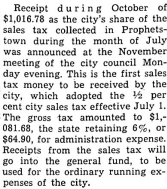
From the Echo, November 7, 1956:


One Response
Very interesting article, Fred. Well done!