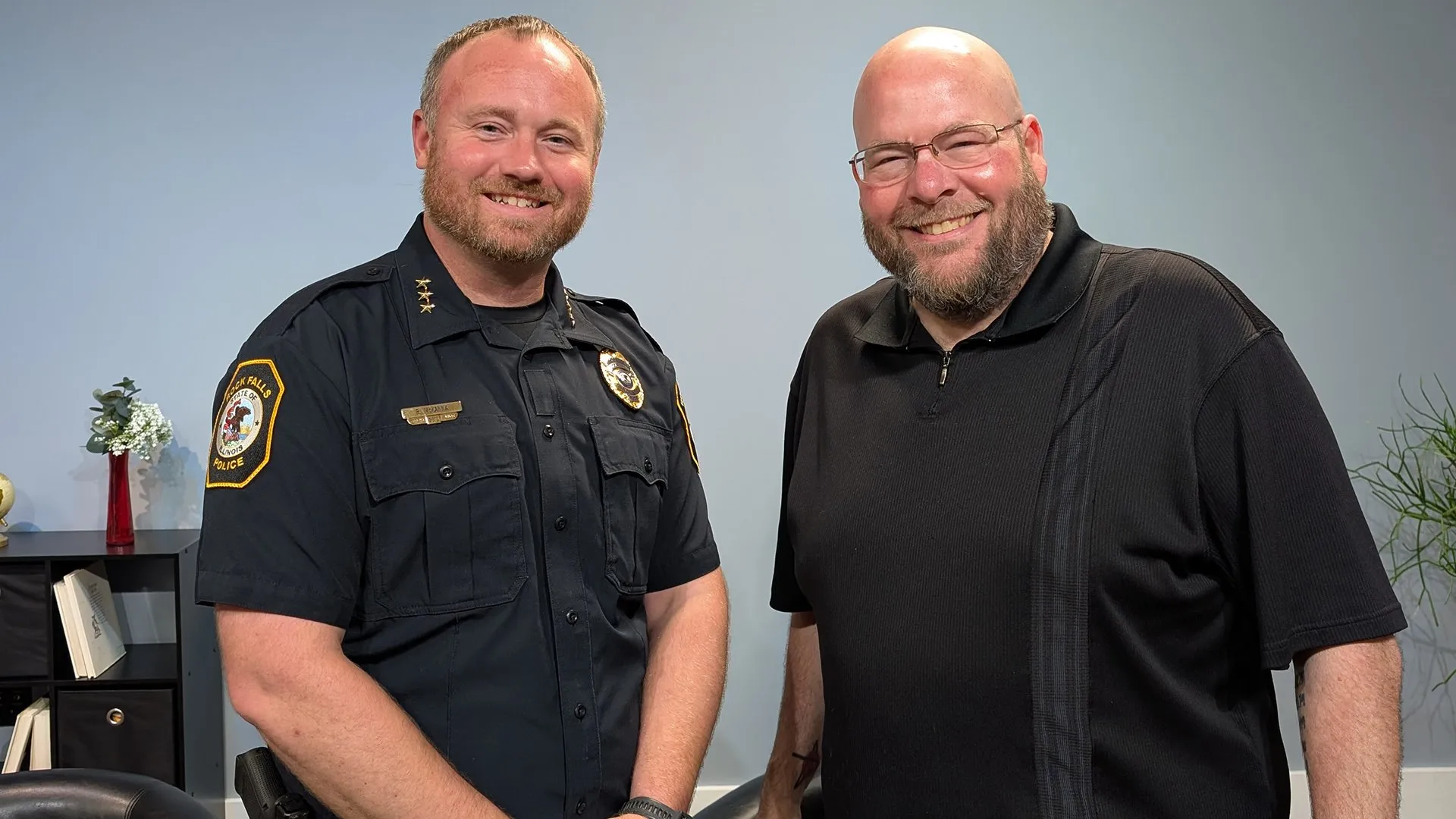
The conversation focuses on what Flock cameras can and cannot do, how officers access the system, the safeguards in place to prevent misuse, how long information is retained, and how the cameras have assisted local law enforcement investigations.
What Flock Cameras Actually Capture
One of the biggest concerns surrounding license plate reader systems is the idea that police can track a person’s every movement. McKanna explained that the system does not provide that type of continuous tracking.
Rock Falls currently has five Flock cameras. Four are located along First Avenue, while another is near the high school. The cameras capture vehicles as they pass through areas where the cameras are installed.
If a vehicle turns away from First Avenue, for example, the system does not continue following it throughout the city. Flock can show that a particular vehicle was present at a specific location and time, but it does not provide a complete record of everywhere that vehicle travels.
The system also does not identify who is driving a vehicle. A license plate may be associated with a registered owner through additional police databases, but that does not establish who was behind the wheel at the time the camera captured the vehicle.
The cameras are designed to capture vehicles rather than people. They do not use facial recognition technology, and any image of a person that might be incidentally captured would not identify that individual through the Flock system.
Officers Cannot Simply Search Any License Plate
Another topic discussed during the episode was whether an officer can enter someone’s license plate into Flock to see where that vehicle has been.
According to McKanna, officers must have a reason for conducting a search. Flock requires an offense type, while the Rock Falls Police Department also requires officers to enter an associated case number and provide a reason for checking the vehicle.
These requirements are intended to prevent officers from using the system simply to look up vehicles without a legitimate law enforcement purpose.
Even after a Flock search produces information, officers still have additional investigative work to complete. The system may show that a particular vehicle was in Rock Falls at a certain time, but officers must use other resources to determine who owns the vehicle and who may have been driving it.
Auditing Helps Monitor System Use
The discussion also addressed safeguards designed to prevent officers from misusing the technology.
Flock is implementing additional auditing tools that allow agencies to review searches conducted by officers. The system can identify unusual activity, such as an officer repeatedly searching the same license plate an excessive number of times.
Those searches can be flagged for administrative review. Police administrators can then determine whether the searches are connected to legitimate investigations and document the reason for the activity.
The auditing system is intended to create accountability while giving law enforcement agencies a way to identify searches that may require additional scrutiny.
How Long is Information Stored?
The length of time images remain accessible is another area that is changing.
McKanna explained that Flock is moving toward a seven-day default retention period for new agencies, although exceptions can be made for certain investigations.
Rock Falls is currently operating under the older system, which allows information to remain available for up to 30 days. Retention periods can also be adjusted when an investigation requires information to be preserved for a longer period.
Serious investigations, such as a homicide investigation involving a potentially dangerous suspect, may require information to be retained longer. Evidence that needs to be preserved for court proceedings can also be handled differently.
Sharing Information Between Agencies
Flock cameras can also connect law enforcement agencies through shared networks.
Rock Falls officers can see information generated by their own cameras and, in certain circumstances, can access information from other connected systems. If a vehicle travels from Rock Falls into another community with Flock cameras, investigators may be able to determine that the vehicle was captured there.
However, that does not mean Rock Falls automatically has unlimited access to every agency’s information.
McKanna explained that information from other agencies can remain restricted or encrypted. In some cases, Rock Falls may see that another agency has interacted with a shared network without being able to see that agency’s specific license plate searches or case information.
If additional access is needed, agencies can submit requests to one another.
Flock as an Investigative Tool
McKanna discussed several examples of how Flock cameras have assisted Rock Falls Police Department investigations.
The system has been used in hit-and-run investigations when witnesses provide descriptions or possible license plate information. Investigators can use the cameras to help determine where a vehicle may have traveled after leaving the scene and potentially alert other law enforcement agencies.
The cameras have also been useful in stolen vehicle investigations. In one case involving a stolen motorcycle from Rock Falls, the vehicle was later captured by Flock cameras in Sterling. That information helped law enforcement locate the motorcycle, which was eventually recovered.
Flock has also assisted in runaway juvenile cases. In one investigation, cameras helped officers determine that a vehicle associated with runaway juveniles had traveled as far as Pennsylvania. The information provided investigators with another avenue to help locate the vehicle and ultimately bring the juveniles home.
The Cameras Do Not Replace Police Work
While Flock can provide valuable information, McKanna emphasized that it is only one part of an investigation.
Investigators may begin with nothing more than a vehicle description. Flock can help identify vehicles matching characteristics such as color, make, and model that passed through the area during a certain time period.
That information can help investigators narrow their search and potentially identify a license plate. However, finding a vehicle that matches a description does not automatically prove that it was involved in a crime.
Police still need to conduct interviews, gather evidence, speak with victims and suspects, and complete the other investigative steps necessary to establish what happened.
The camera system can point investigators in a direction, but it does not independently solve a case.
Privacy and Public Spaces
The episode also explored broader questions about privacy in public spaces.
McKanna noted that people generally have a lower expectation of privacy when they are in public. Vehicles traveling on public roads are visible to other people, and license plates can be seen by members of the public.
That does not mean police have unlimited authority to search a vehicle. Separate legal standards still apply when officers want to search the inside of a vehicle or take other enforcement actions.
The distinction between observing something that is publicly visible and conducting a search was an important part of the discussion.
Addressing Legitimate Concerns
McKanna acknowledged that concerns about license plate reader technology are legitimate and that members of the public should be able to ask questions about how the systems are being used.
There have been cases nationally involving misuse of license plate reader technology, including allegations involving stalking and inappropriate searches. McKanna said those concerns should not simply be dismissed.
At the same time, he emphasized that the misuse of the technology by some agencies does not necessarily reflect how every department operates.
Auditing requirements, case numbers, and documented reasons for searches can provide additional accountability and help agencies determine whether the technology is being used appropriately.
The Technology Could Continue to Change
Another major point from the conversation was that the rules surrounding license plate readers are not necessarily permanent.
Technology continues to evolve, and legislation and court decisions can change how law enforcement agencies are permitted to use these systems.
McKanna pointed to the broader history of law enforcement as an example of how procedures can change over time. Court decisions and new laws have repeatedly established new requirements for police officers and agencies.
The same could happen with license plate reader technology as lawmakers, courts, and communities continue to examine the benefits and concerns surrounding its use.
Along the Rock is produced by the Radar Free Press. The Radar Free Press is free to the public and relies on community support through likes, shares, and comments.
If you have any questions for recurring guests or episode ideas, please email us at alongtherock@theradar.online.