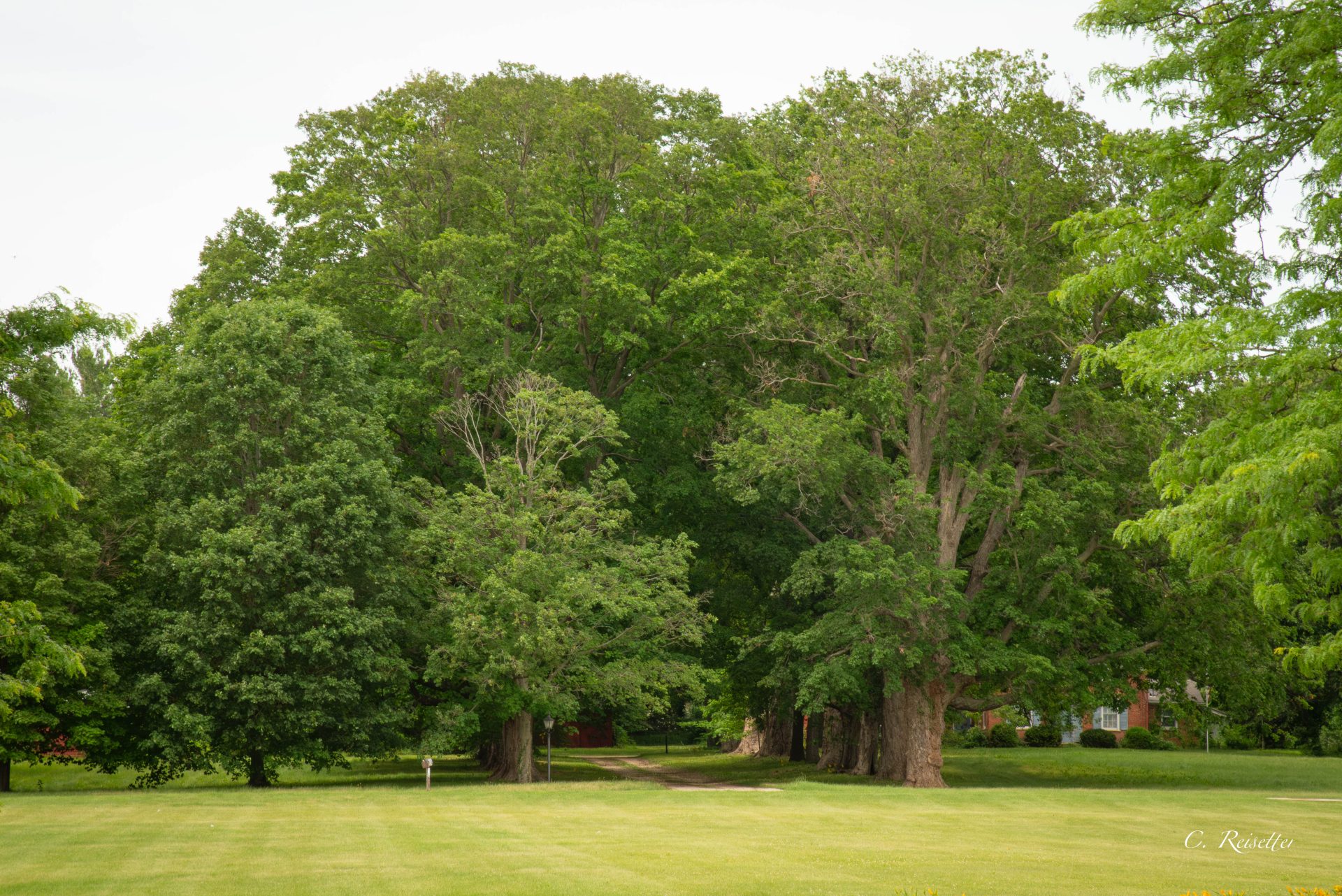
The location of this allée of trees is on private property on Guilford Road in Rockford. The allée of 35 Sugar Maples can be seen from the road. The nominator, April Bieschke, said her mother, Karen Bieschke, has been associated with these trees for fifty years as Karen’s parents lived there and now her. Karen has received many comments from people about how much they love seeing the changing colors throughout the seasons.
Karen said, “That these trees have lived so long is amazing, and it’s even more special because we know their stories. For the man who planted them, they were the hope for the future. For the caretakers over the next century and a half, they were a reminder of beauty, resilience and responsibility. And now, as we reflect on the history of this allée of trees, we are reminded of the need for the quiet haven that is provided in nature and underscores the absolute necessity to preserve natural spaces forever. Speaking for the seven landowners, thank you for recognizing our trees.”
Groves of Sugar Maples have graced what is now the eastern edge of Rockford since before Euro-settlement – the trees were documented in the original land survey starting in 1836 and listed as “sugar trees.” Sugar Maples were tapped by native peoples for their sweet sap and are to this day – their sap distilled down into beloved maple syrup.
Locals called the tree hard maple because of its strong wood (as compared to silver maple which was known as soft maple because of its weak wood). Sugar Maples grow slow and steady and live for centuries, their strong wood valued for gymnasium flooring and cutting boards because of its natural antiseptic and rot resistant qualities. Dendrochronologists, people who study tree rings, hate sampling these trees because it is so difficult to take a core sample from the dense wood.
Relics of the original Sugar Maple groves of east Rockford can be seen in the aptly named Maplewood subdivision between Newburg Road and Charles Street and with additional woodlots remaining along both thoroughfares. Groves extend north along eastern parts of Guilford Road and along the upper reaches of Keith Creek at Mulford – where some large trees can be seen at the Rockford Park District’s Rockford Arboretum Park. This allée of sugar maples is a part of this historic “sugar bush” (as groves of sugar maples are known).
This allée of trees was likely planted by digging up local wild sugar maples and planting them along the lane going back to this old estate/farmhouse. William Coy, considered a pioneer settler of Winnebago County, purchased the land in 1844 and built the home that still exists to this day and other buildings. He acquired several hundred acres over the years and was called a “successful agriculturalist.” Coy planted fruit and ornamental trees, including this allée of Sugar Maples leading to the historic home.
The trees have since grown together to create quite a shady tunnel. Certainly, their roots have all grafted together and they likely help each other out and function as a team — facts revealed in the recent book “The Hidden Life of Trees.” This is why the whole allée is nominated as a Legacy Tree with the largest one measured at 73 feet tall, with an average crown spread of 64 feet, and a trunk circumference of 147.6 inches (12.3 feet!).
Sugar Maples have a high wildlife value, supporting a wide diversity of insects including many specializing on the tree such as the beautiful Rosy Maple Moth. The tree has lovely pendant, though tiny, flowers in spring before it leaves out so that the tree looks covered in a chartreuse shag – a nice compliment to woodland wildflowers that thrive beneath them including woodland phlox and Virginia bluebells that flower at the same time. Sugar Maples are also valued for their beautiful fall color – from yellow to orange and red, sometimes all colors on the same tree. They are the epitome of fall color for native trees in our region.
“To be featured by NLI will hopefully bring the importance of preservation to the forefront,” said Bieschke. “The reason I’m living on this property is because after my father went blind and could no longer live here, a developer came to the back door and asked if the old gentleman who lived here might be interested in selling the five acres. When I asked if he liked old houses and trees, he replied, ‘No, I think if we take down the house and trees we can get five or six lots back here.’ That was the day I went and told my father that I wanted to buy his home. As they say, the rest is history.”
Karen said “Thank you for acknowledging the ecosystem of the trees. I think my favorites (right now) are the hawks who bring their newly fledged young to the trees to practice hunting and preen their feathers. In the fall, it’s the owls who ‘talk’ back and forth across quite a distance – seemingly perched in the other big trees across Mulford Road.”

Nominator April Bieschke and her mother, Karen Bieschke. Photo by Christopher Reisetter.
Background Information:
Natural Land Institute launched the Legacy Tree Program in January 2024. Anyone may nominate a tree on private or public land from NLI’s 12 county region. To see monthly stories, for more information and a nomination form visit: https://www.naturalland.org/nlis-legacy-tree-program-january/ or call 815/964-6666.
NLI, an accredited land trust, is a 501(c)3, not-for-profit land conservation organization based in Rockford, IL and has protected 19,000 acres of natural land in Illinois since 1958. NLI’s mission is to create an enduring legacy of natural land in northern Illinois for people, plants and animals. For more information and to donate visit: www.NaturalLand.org.