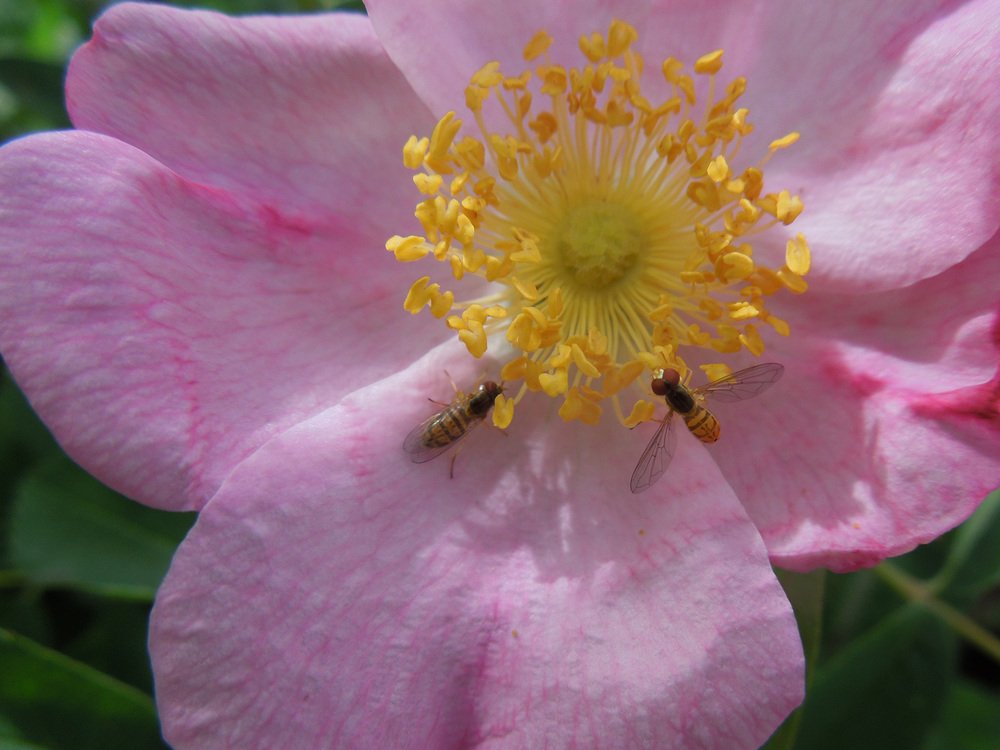
If so, chances are you’ve encountered syrphid flies. These harmless insects are often mistaken for bees or wasps. While their habit of buzzing around people can be annoying, syrphid flies are some of the most beneficial insects you can find in your garden.
Is it a bee, wasp, or fly?
Adult syrphid flies (aka hover flies, flower flies, corn flies, helicopter flies, and sweat bees) range in size from ¼ to ¾ of an inch long. Many of them are excellent mimics of bees and wasps, with yellow, orange, and black markings. Like bees and wasps, the adults are often seen around flowers. There are a few different ways you can tell them apart from one another:
- Look closely at the wings. Flies have one pair of wings (2 total), while bees and wasps have two pairs (4 total). As the adage goes, two wings fun, four wings run.
- Look at the antennae, syrphid flies have short antennae, while bees and wasps have longer, elbowed antennae.
- The eyes of flies are large and will cover most of their face, while the eyes of bees and wasps are on the sides of their heads and take up less space.
Beneficial role of syrphid flies
Despite their annoying habit of swarming and landing on us, presumably to get moisture and salt from our sweat, most syrphid flies are quite beneficial. The adults are important pollinators and are often seen visiting flowers in gardens.
In addition to acting as pollinators as adults, many syrphid fly species are predatory as larvae, feeding on aphids and other small, soft-bodied insects such as mealybugs, scales, and thrips. Females will lay their eggs on plants near or among aphid colonies. After about three days, the eggs will hatch. The larvae are legless, with a tapered body, and range in color from creamy white to green or brown. They will crawl around in search of food.
Syrphid fly larvae can be quite voracious; a single larva can eat up to 400 aphids during its development. So, if you ever see an aphid infestation in your garden, make sure you check to see if there are any syrphid fly larvae around before getting too worried. The larvae will feed for seven to ten days before they pupate. After around ten days as a pupa, the adults will emerge to continue the cycle.
Attracting syrphid flies to your garden
There are several things you can do in your landscape to make your landscape more attractive to syrphid flies:
- Make sure you provide flowering plants throughout the growing season. Some popular flowers with these insects include Queen Anne’s lace, sweet alyssum, coriander, dill, and other small-flowered herbs.
- Allow some pests to be in your landscape. The larvae of many species are predatory; if there isn’t any food for the larvae to eat, they’re more likely to move on.
- Limit pesticide applications. Avoid using broad-spectrum insecticides, as they kill both pest and beneficial insects.
Good Growing Tip of the Week: Syrphid flies have sponge-like mouthparts that they use to feed on nectar, pollen, and, if they land on humans, sweat. Despite what many people think, they don’t bite or sting. If you do get stung by a small insect feeding on your sweat, it is most likely a ‘true’ sweat bee.
| ABOUT EXTENSION: Illinois Extension leads public outreach for University of Illinois by translating research into action plans that allow Illinois families, businesses, and community leaders to solve problems, make informed decisions, and adapt to changes and opportunities. SOURCE: Ken Johnson, University of Illinois Extension, Horticulture Educator, kjohnso@illinois.edu or 217-243-7424. |