

I was born in August 1938 and lived most of my first five years in a log cabin about 60 miles from Miles City, Montana. The cabin was owned by Frank and Elsie Ducello, my mother’s parents. Even after we moved to town, I spent months out in that cabin. We had no electricity (thus, no refrigerator), no running water, and no inside toilet. We had a well 34 feet deep, dug by my Grandpa Frank, where we kept our milk cool by placing it on a platform in the water.

In April 1942, we moved to a home in Miles City. Still no refrigerator. Shortly thereafter we moved to another home that did have a refrigerator. In August 1944, we moved to 601 Missouri Ave., on the south side of Miles City. There we had a refrigerator, but it did not work, so was used for an ice box. A couple of blocks from our house was an ice house, where they manufactured ice. Many folks had no refrigerator, so the ice man came around every few days, delivering ice to those who needed it. There was a sign placed in the front window telling him that we needed ice. He placed a large rubber sheet on his shoulder and, using ice tongs, carried the ice into your house, placing it on that sheet of rubber. Quite often my mother had Carroll, my brother, and I pull our wagon over to the ice house, buy a chunk, and bring it home. Our non-working refrigerator looked like this one, only in better shape.

A few years later, my grandmother Ducello, who lived with us part-time, received a check from the fellow who farmed her land and purchased a Coronado refrigerator from Gambles for us. What a treat that was; no more trips to the ice house.
Naturally, Prophetstown has a similar story. Folks here did not get electricity until 1896. Even then few people connected to it. Thus, our need for an ice business. Here is what Carl O. Swanson recalled about the ice business, which was owned by the Warner family:


Here are some pictures of our ice industry in operation.
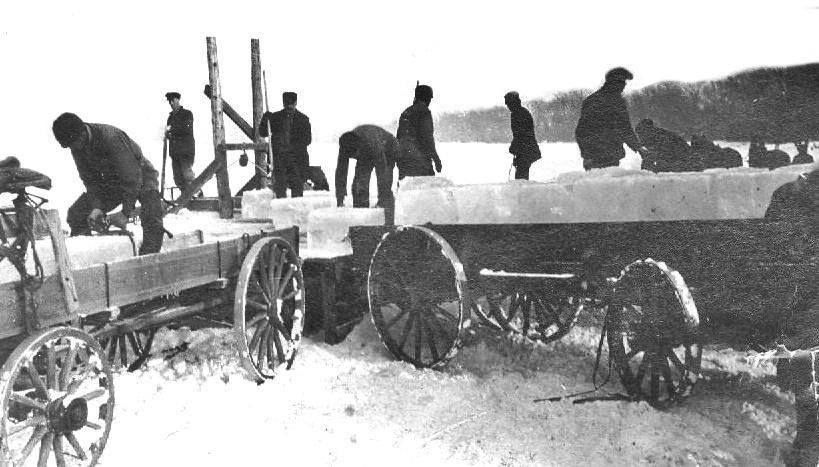
1880 – George Turner and men hauling ice out of the Rock River.


The ice ramp in 1890.
The blocks of ice were pulled up this ramp and deposited in the ice houses,
which were located on the North side of Water Street (later Riverside Drive).
From A View From Thunderbolt, 1859-1959, we get this info:
“But a good ice crop was a thing of joy in those days. N. C. Warner reaped a good harvest that year (winter of 1899-1900) and come out with a new wagon for delivering ice.”
The harvesting of ice blocks was not without danger as this 1914 entry from A View from Thunderbolt, 1859-1959 shows:
Notice – it mentions “ice houses.” Where were our ice houses?

Riverside Dr. was Water Street in 1913. Also, notice that it does not yet go through to the Park. And notice that Washington Street continues on to the river, which is not true today. On the northwest corner of Water and Washington, there is a dwelling. Next to that were the ice houses roughly where the houses at 102-106 W. Riverside Dr. are now located.

As seen from Google Earth.
From the Prophetstown Echo on January 3, 1917:
From the Prophetstown Echo February 18, 1925:
“N. C. Warner had put up 2,000 tons of ice from the river since Jan.1. One thousand tons of this was shipped in 30 carloads to Tampico and Walnut. Elwood Beeman was in charge of the work.”
A reasonable question would be: “What brought an end to our ice harvest on the Rock River?” Carl O. Swanson, in his recollection above, noted that when the sewer plant was installed, the harvesting of ice stopped. Before the sewer plant, each family had an outhouse or an underground septic system of some sort. Once the sewer plant began to dump water into the Rock River here at Prophetstown, it was considered unsafe to keep the river ice industry going.
But we still needed ice. In 1923, a contract was let for an artificial ice plant to be constructed on East Railroad Street.
From A View from Thunderbolt, 1859-1959:

This is where the Clark Ice Plant was located. It was demolished in 2021.
Not only was this an ice plant, but they also provided lockers in which people could keep their frozen items. Many homes had no refrigerator. If they did it had no freezer or if it had one it was very small. We came to town in August 1964 and rented a home from Earl Thicksten located at 411 West Riverside Drive. The refrigerator had a freezer compartment, but it was only large enough to hold 3 ice cube trays. So we rented a locker here on East Railroad Street and that is where we kept our frozen foods. We found out many years later that a couple of young fellows found a way to get into the lockers, removing steaks and other items they wanted.
Clark’s locker memories from Roger Schaeffer:
“About Clark’s Locker. Owned by Kenny Clark, a caring gentleman, an excellent butcher, a volunteer fireman, and a community servant who trusted everyone by never locking the entrance to the locker. The big blocks of ice were always on the floor inside the big freezer that housed all the locker drawers we rented and had a key, to store our butchered and frozen, wrapped meat that Kenny had processed for us. He charged a fee for the service of course. There was a pad and pencil on a little desk with your name on it and you put your time and date by your name when you took a block of ice. “Lots of us had no electricity in the forties, so we used “ice boxes” to keep our food fresh. We could pick up the ice blocks at any hour of the day or night. We used “ice tongs” to load it into the car trunk or pickup, took it home and used “ice picks” to chip it into small enough pieces to fit in our ice box, which looked like a little refrigerator. “Most of us farmers in that era killed, bled out, gutted, and skinned the beef animals or pork animals. We would take the remains to Kenny’s and he would let it hang a little while, then cut it into steaks, chops, and grind it into hamburger, sausage, or whatever the customer wanted. He would wrap and freeze the cuts into meal-sized packages and put them in the locker drawers we had rented. We had access to the locker area 24/7 and we had a key that just fit our locker, just like a safety deposit at the bank. Only with no attendants present.
“The locker building is still there [demolished in 2021]. It’s on Railroad Street, the next building across the alley east of Gardner’s Funeral Home. I think there was another locker next to that, but I’m not sure. We just used Clark’s.
“Kenny was a volunteer fireman when the fire station was where the police station is now and remained on the force for many years. I was a volunteer fireman when he was still on the force after the new fire station was built. He was a dedicated servant and never missed a call. Just couldn’t drive a truck without endangering everything in his path. Too rambunctious I think. No fear of anything, Sharp knives, cleavers, power meat saws, being trapped in a killing cold freezer, running into a burning building to save someone or some pet, nothing that I know of, not even beer or whiskey. I think he was the only one that worked at his business, but I might be wrong about that. I don’t remember seeing anyone else in there. He would buy some of the beef carcasses and pigs from the local farmers and sell them to Fadden’s and other meat markets to make ends meet. It took lots of electricity and maintenance to keep those big freezers cold, so he needed every dollar he could earn. He was never wealthy. Just a great servant to us all, and asking no one for free help.”

2 Responses
That was a very interesting article, I remember Kenny Clark after I got married. Thank you, Fred.
Great article!! Thank you again!! Fred South,